Skip to main content Skip to footer

How to become a pharmacy technician

This guide explains the full career pathway to becoming a pharmacy technician in NHS Scotland. It is a skilled, hands-on profession. As a registered pharmacy technician, you’ll be responsible for the safe and efficient supply of medicines.

Salary

At NHS Scotland, your salary doesn’t stand still. We reward you for the skills you bring and increase your pay as you gain experience. Find out more about pay and benefits.

Entry
Experienced

Entry

£30,353

Qualified pharmacy technicians in the NHS start at £30,535 per year before tax.

Annex 21 is a pay and banding arrangement for trainees in NHS Scotland. Pre-registration trainee pharmacy technicians are paid a percentage of the qualified salary. This increases annually as they progress through their training programme, until they become qualified and registered with the GPhC.

Experienced

£59,159

Lead pharmacy technicians and specialist pharmacy technicians in the NHS can earn up to £59,159 before tax.

What is a pharmacy technician?

Pharmacy technicians are registered healthcare professionals who work alongside pharmacists and other healthcare staff. They prepare and dispense medicines to make sure patients receive safe and effective care.

Their responsibilities are essential to the pharmacy team.
  • Preparing and dispensing medicines, including complex items like chemotherapy or sterile feeds.
  • Taking medication histories from patients when they are admitted to hospital.
  • Carrying out final accuracy checks on prescriptions before they are given to the patient.
  • Carrying out medication reviews with patients during home visits.
  • Advising patients on how to take their medicines safely, use devices like inhalers, and manage side effects.
  • Providing health advice in a community pharmacy, such as for stopping smoking or vaping.
  • Managing medicines stock, ordering supplies, and handling the secure storage of all medicines.
  • Training and supervising new pharmacy support staff.
What is a pharmacy technician?
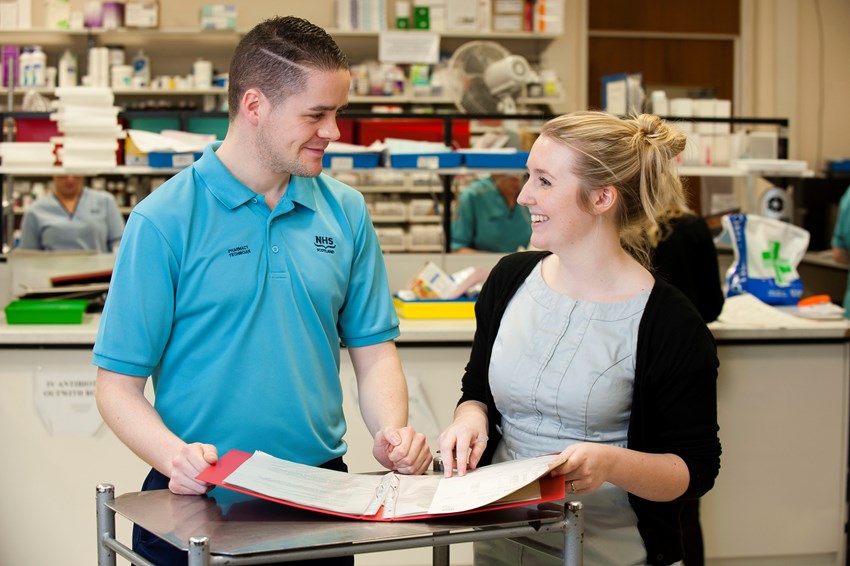
Pharmacy technician discussing medication management with a pharmacist

Education and training pathway

There are 2 routes to becoming  a registered pharmacy technician in Scotland:

  • Technical Apprenticeship in Pharmacy Services at SCQF level 8
  • Diploma in Pharmacy Services at SCQF level 7

These are both 2-year paid, work-based programmes that combine practical experience with structured learning. 

To get a place on one of these programmes, useful school subjects include:

  • Chemistry
  • Biology
  • Maths
  • English

Speak to your guidance teacher or careers adviser about the subjects offered at your school.

Get relevant experience and insight

Getting experience, such as through a work placement or volunteering in healthcare, can help your application. It shows your commitment, helps you develop new skills, and gives you a realistic understanding of working in a pharmacy.

Learn more about work placements and volunteering.

Apply for pharmacy technician training

Instead of applying to college or university, you’ll apply for a pre-registration trainee pharmacy technician job.
These are paid training opportunities. You’ll be an employee of an NHS Scotland Health Board while you learn. Your training and qualification costs are covered.

You can find current trainee vacancies on the NHS Scotland recruitment website.

How long does it take to become a pharmacy technician?

Both the Technical Apprenticeship and Diploma in Pharmacy Services take 2 years to complete.

What is the apprenticeship really like?

Your 2-year training will be a mix of on-the-job learning and formal study. You’ll:

  • Join the pharmacy team and work with qualified pharmacists and pharmacy technicians.
  • Rotate through different areas, such as hospital wards, the main dispensary, aseptic units, and GP practices.
  • Be given dedicated time to study.
  • Build a portfolio of evidence to show you meet the required standards.

Join the GPhC register

When you complete your 2-year training programme and pass all your assessments, you’ll be awarded your qualification. This will allow you to apply to join the General Pharmaceutical Council (GPhC) register as a pharmacy technician. You must be on the register to practise in the NHS.

Learn more about the GPhC register.

Get to know the role

As a pharmacy technician, you are an essential member of the pharmacy team. 

You'll use your technical knowledge and practical skills to make sure medicines are prepared, checked and supplied safely and accurately. Working closely with pharmacists and other healthcare professionals, you'll contribute to the safe and effective running of pharmacy services. You may also provide direct care and advice to patients and the wider public.

Your role may vary depending on where you work.

Community pharmacy

In community pharmacy, you'll help supply medicines safely and efficiently. You'll also work directly with patients to support their long-term health. This could include:

  • dispensing and checking medicines
  • managing stock and supervising staff
  • giving advice on medicines
  • providing public health services

Hospital pharmacy

In a hospital pharmacy, you'll supply medicines to wards, clinics, and dispensaries. You'll also make sure that patients receive safe and accurate treatment. This could include:

  • dispensing medicines and preparing sterile products (aseptics)
  • managing stock on wards
  • checking medication histories (medicines reconciliation)
  • helping plan for when patients leave hospital
  • giving advice to patients and clinical teams

You may also supervise staff or take on specialist technical roles to improve patient safety.

Primary care

In primary care, you'll work in GP practices and with the wider healthcare team. You'll manage prescriptions and help patients use their medicines safely. This could include:

  • managing repeat prescriptions
  • reviewing medicines and checking records
  • helping patients understand their treatment
  • improving how the practice manages medicines

Your main tasks could include:

  • Interpreting prescriptions and performing a final accuracy check to make sure they are correct.
  • Preparing and dispensing medicines for patients.
  • Managing the pharmacy stock, including ordering, stocktakes, and secure storage of medicines.
  • Reviewing and recording patients' medication histories when they are admitted to hospital.
  • Providing advice to patients and other healthcare staff on how to take and store medicines safely.
  • Training and supervising pharmacy support workers and assistants.
  • Recording information and analysing data.

To succeed as a pharmacy technician, you’ll need to develop a unique set of timeless, high-level skills, known as meta-skills. These are the core abilities that will help you adapt and excel throughout your career.

Self-management

This is about how you manage yourself and your work in a busy environment where safety is critical.

  • Focusing—Maintaining absolute precision and attention to detail when checking prescriptions or calculating doses. A small error can have big consequences.
  • Adapting—Being resilient and able to prioritise urgent tasks in a busy dispensary, such as an emergency prescription for a critical care ward.
  • Initiative—Taking ownership of the medicine supply chain, spotting a potential stock shortage, and acting to resolve it before it becomes a problem.
  • Integrity—Acting in an honest and ethical way. You must uphold strict laws and procedures for controlled drugs and always protect patient confidentiality.

Social intelligence

This is about how you connect with and understand patients and colleagues.

  • Communicating—Explaining clearly to a patient how to use an inhaler or listening carefully to an anxious patient's concerns.
  • Feeling—Showing empathy and compassion when taking a medication history from an elderly or distressed patient, making them feel at ease.
  • Collaborating—Working closely with pharmacists to query a prescription. You’ll also support nurses on the ward or in the community so that medicines are delivered safely and on time.
  • Leading—Clearly and respectfully training new support staff on complex procedures, like dispensary protocols or stock management.

Innovation

This is about how you approach problems and adapt to new developments.

  • Curiosity—Having a commitment to lifelong learning to keep up with new medicines, technologies like automated-dispensing robots, and safety guidelines.
  • Creativity—Suggesting new ways to organise the dispensary layout or patient workflow to make it safer or more efficient for the team.
  • Sense-making—Identifying a pattern in patient queries or dispensing errors and understanding the root cause.
  • Critical thinking—Analysing a complex prescription against a patient's records to identify potential technical issues. This could include out-of-stock items or duplicate therapy.

Learn more about meta-skills on My World of Work.

You could work with:

  • pharmacists
  • pharmacy support workers
  • GPs
  • hospital doctors
  • nurses
  • allied health professionals
  • healthcare support workers
  • other pharmacy technicians

Where you'll work
Your working hours will often be on a rota, which may include evenings, weekends, and public holidays.

You could work in these settings:

  • hospital pharmacies
  • community pharmacies
  • GP practices
  • prisons
  • NHS Scotland Health Board headquarters, working in education or within medicine management teams

Your career development

As a registered pharmacy technician, you are expected to engage in continuous professional development (CPD) to keep your knowledge and skills up to date.

Revalidation

You must renew your registration with the General Pharmaceutical Council (GPhC) every year.
As part of this, you must complete revalidation. This demonstrates to the GPhC that you remain fit to practise and are keeping your skills current.

Learn more about the revalidation process for pharmacy technicians.

Career progression

As you gain experience as a registered pharmacy technician, there will be many opportunities for you to progress. With training, you could choose to specialise in an area of pharmacy such as:

  • medicines management
  • general practice
  • procurement
  • clinical trials
  • education and training
  • information technology and digital solutions
  • aseptic
  • care at home
  • oncology
  • paediatrics
  • medicines information
  • research and development
  • service development and management
  • clinical pharmacy

You can also move into management, such as becoming a lead pharmacy technician supervising a team or section.

Professional bodies

To work as a pharmacy technician in the UK, you must be on the General Pharmaceutical Council (GPhC) register.

You can also join the professional leadership body for technicians, the Association of Pharmacy Technicians (APTUK).

Published: 26/03/2023

Last updated: 04/12/2025

Part of: Explore careers

Topic: Pharmacy

Explore careers

Explore careers

Discover the skills and qualifications you’ll need for each role and what the work will be like.

Explore careers

NHSScotland Careers blog

Our blog includes how-to guides, case studies, and career resources.

Discover more