
Claire Cameron
13 March 2026
•2 min read

Finding my passion early
Healthcare Science Week is the perfect time to celebrate the people keeping the NHS running safely. I completed my GCSE work experience in clinical engineering. From that moment, I just knew this was the exact career path for me.
I was fascinated by how technology, problem-solving, and patient care all came together. I loved seeing how behind-the-scenes work could have such a meaningful impact on people's lives. After school, I studied Medical Engineering at Cardiff University.
Building my practical foundations
After graduating, I returned to the alternative and augmentative communication service. That's where I first did my work experience, but by then I was a specialist clinical technologist. I spent 2 years in this role and loved every minute of it.
I worked in a multidisciplinary team alongside health and education professionals. We supported patients who relied on communication aids to express themselves. I interacted directly with patients and adapted bespoke technological solutions for their complex needs.
The work was highly rewarding and gave me a strong understanding of the NHS. It really helped me see how our services operate in practice.
Taking the next big step
My time as a clinical technologist helped me see the bigger picture. I realised my area of work was quite niche, and I wanted to broaden my skills. That led me to apply for the Scottish Clinical Scientist Training Scheme in 2019.
I began by studying for a master's degree in Biomedical Engineering at the University of Strathclyde. I completed an interesting project in rehabilitation engineering during this time. This academic grounding was followed by a practical foundation year.
I rotated through different areas of clinical engineering within a health board. These rotations allowed me to explore the huge breadth of healthcare science. They helped me understand exactly how different services connect with each other.
Seeing the bigger picture
I spent valuable time in clinical measurement departments during my foundation year. This helped me understand the reality of working in busy patient-facing environments. Balancing safety and real-world clinical pressures is a key part of my job.
Life beyond my training
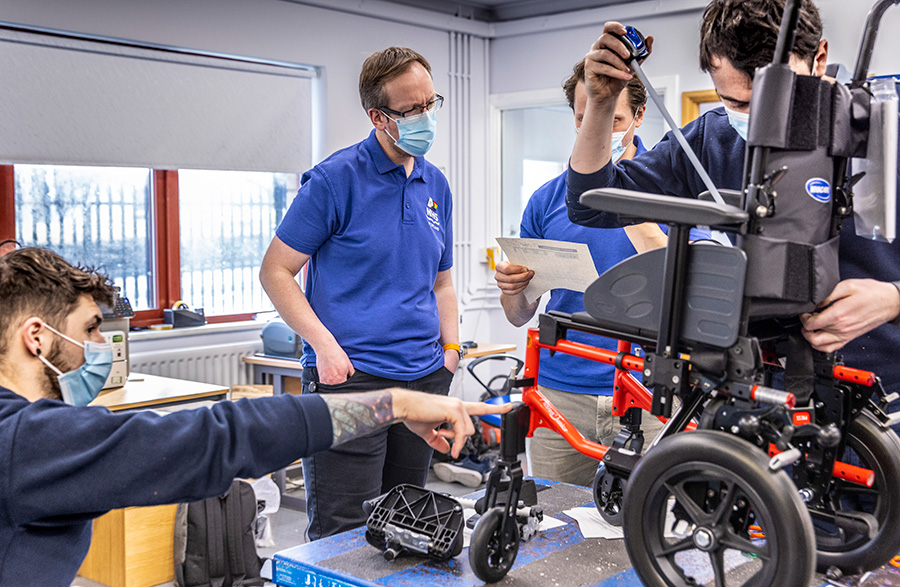
I finished my training and became a clinical scientist in 2023, registered with the Health and Care Professions Council (HCPC). I managed to find a role that perfectly mixed my experience in rehabilitation engineering and device risk management. I now help with rehabilitation services like wheelchairs, prosthetics, and orthotics.
We develop quality management systems to comply with medical device regulations for our bespoke patient equipment. A big part of my role involves translating complex standards into everyday clinical language. I work with teams to write down their practices and add anything the standards require.
I also work in the environmental controls service one day a week. I see patients and problem-solve to find solutions that help them control their surroundings. It's very rewarding to give them independence when a health condition prevents them from doing so.
I even help lead a sustainability group in our centre. I project manage teams to look at our manufacturing and administrative processes. We're actively finding ways to make them reach net zero!
After 3 years of being qualified, I'm still learning a huge amount. I love clinical engineering just as much as I did when it captured my attention as a fifteen-year-old. The variety of my work is great fun!
Why choose healthcare science?
The role of clinical engineering is expanding rapidly across acute and community settings. Clinical engineers have a vital role in patient safety, innovation, and service improvement.
If you want a career combining science, technology, and real-world impact, we offer great opportunities. It might even start with something as simple as a work experience placement or an insight day.
Abigail says, "I'm proud to be part of a profession making a difference every single day."
Check out our clinical engineer job profile to learn more.